
Puzzle
Lottozero Kunsthalle, Prato
Via Arno 10, Prato
07.03 – 31.05.2026
Curated by Alessandra Tempesti
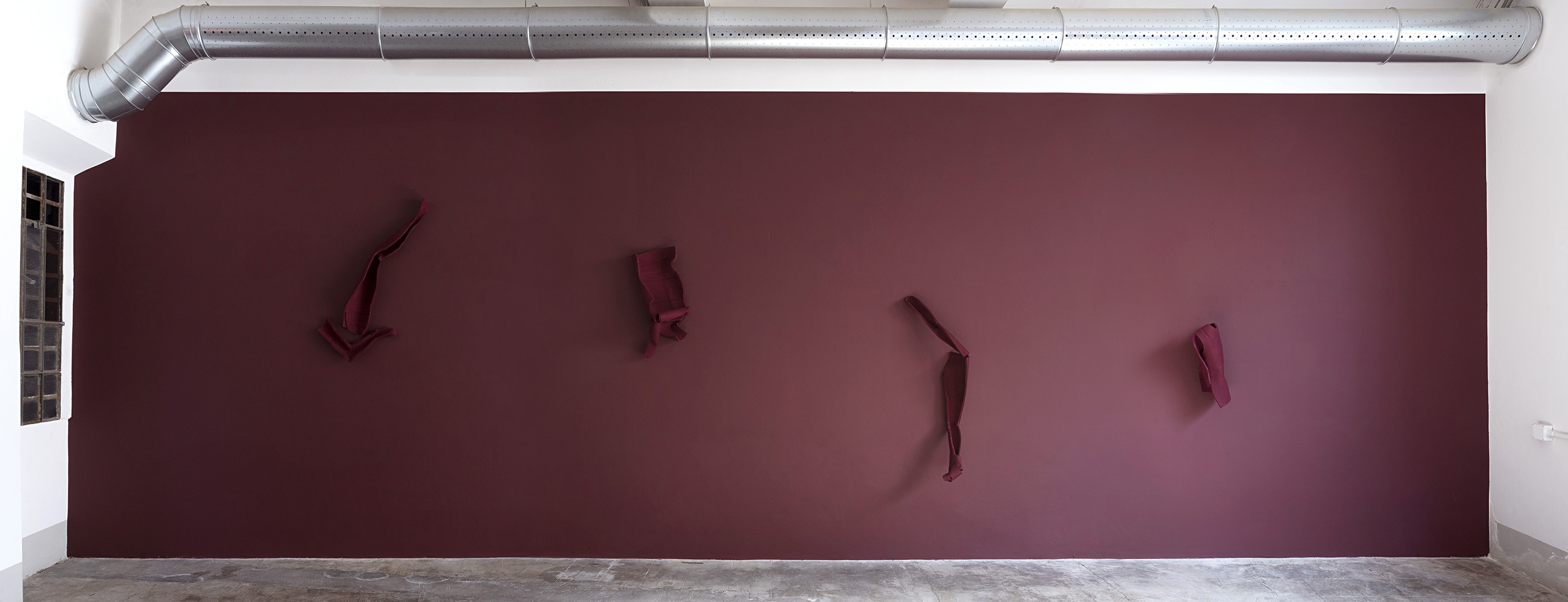
Puzzle, veduta parziale.
I will never know my body, I will never know myself as a body, precisely where “corpus ego” is an unquestioned certainty. Others, on the other hand, I will always know as bodies.
Jean-Luc Nancy (1)
Puzzle, in the figurative sense of an enigma, to be unravelled and pieced together: the enigma of the body, being simultaneously the subject and object of its own perception. From this stems the fundamental difference between portrait (of another’s body) and self-portrait (of oneself): the latter becomes an impossible undertaking, yet one continually attempted, within a territory rendered impracticable by the intrinsic contradiction of self-representation. Thus, the parameters of sculptural modeling are overturned and blurred within a monochromatic environment without coordinates or reference points: empty space merges with the red of the sculpture, the sculpture’s volume with the void; the interior becomes a liminal surface, and the body appears as partial anatomy.
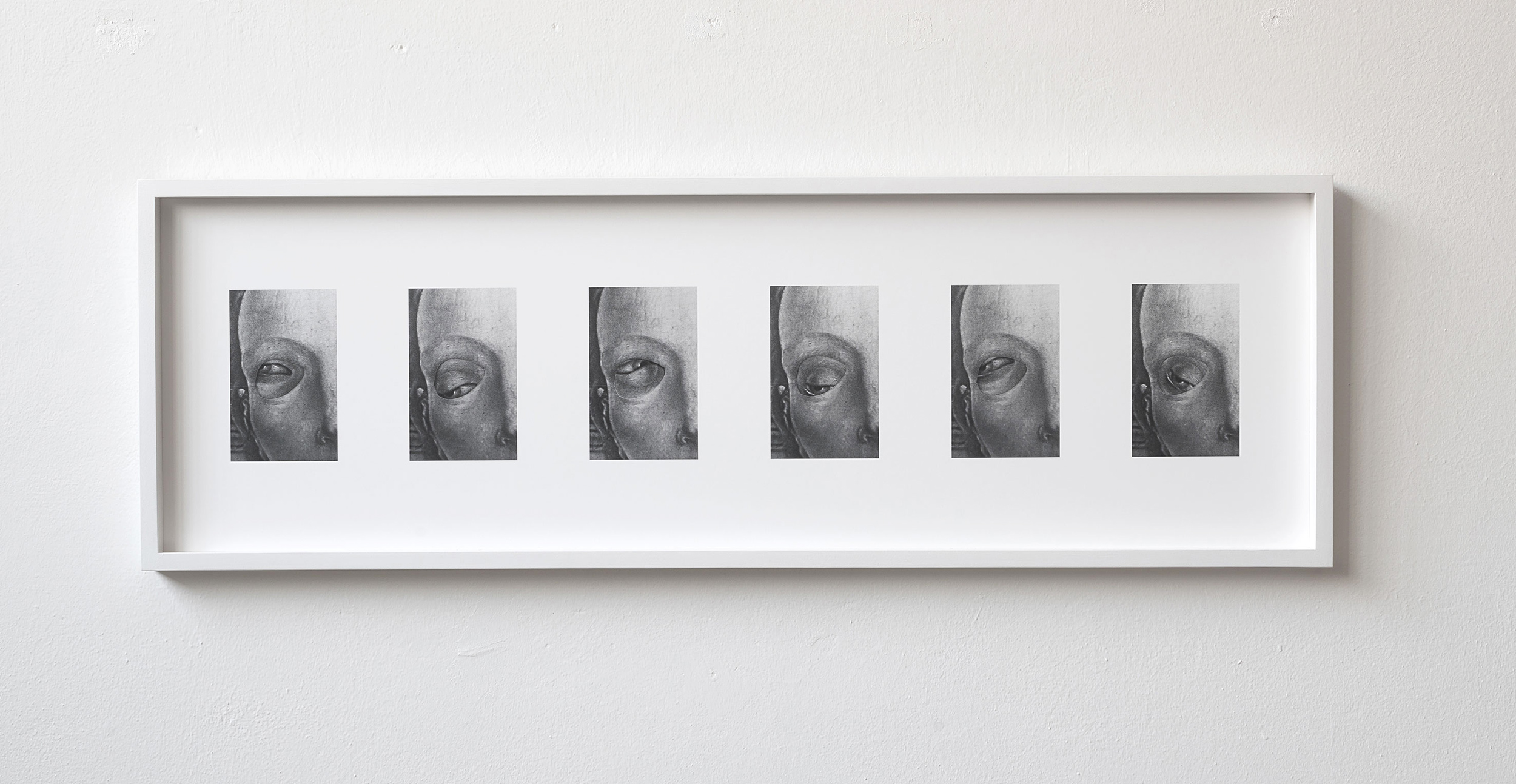
Puzzle, ‘Ciò che resta’ 2026, fotografia digitale su carta cotone.
For Daniela De Lorenzo, self-portraiture is essentially a self-withdrawal of the subject—an act that is failed, deferred, and fragmentary. And in this sense, it permeates much of her artistic production, both sculptural and photographic. The felt sculptures are casts of her own body, imprinted in the moistened layers of industrial felt — a material itself created by the compression of wool fibers —chosen by the artist for its ability to retain the memory of the gesture, returning the spasm of a contraction or the release of tension as a limb yields to gravity.
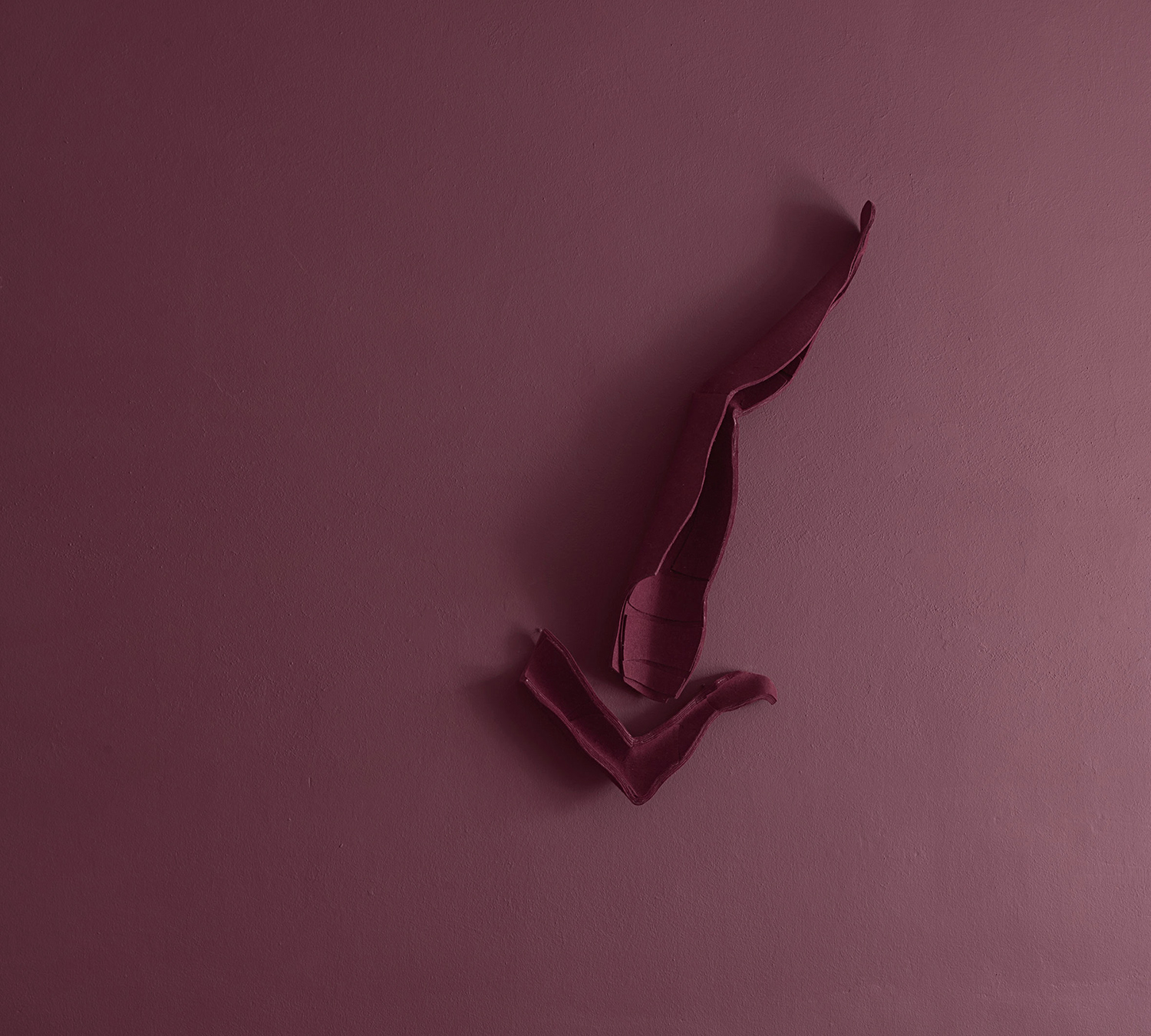
Puzzle, particolare, feltro.
For her solo exhibition at Lottozero, De Lorenzo presents a new series of felt sculptures that integrates a core of pre-existing works into an installation and environmental setting, transforming the Kunsthalle spaces into a score of poses and gazes. The eye reads the hollow forms of the anatomical casts as parts of a whole that exists only in their virtually infinite combinatorial possibilities. The sculpture becomes a plastic fragment in stop motion, rediscovering in the principle of animation a dynamism, a rhythm, a time through which to seek the unfolding of identity, which escapes the static nature of the single image. However, the assembly follows a spatial rather than a temporal logic, with the sequential (cinematic) model being replaced by the paratactic model of addition. As in cycles of frescoes in which scenes coexist on the wall in a diachronic or synchronic sequence, the postures stand out from the background, side by side, one with the other, partitions of the same body and multiple inner states. It is no coincidence that the artist “frescoes” the entire wall with a wash of colour that spills over into real space, becoming part of the architecture.
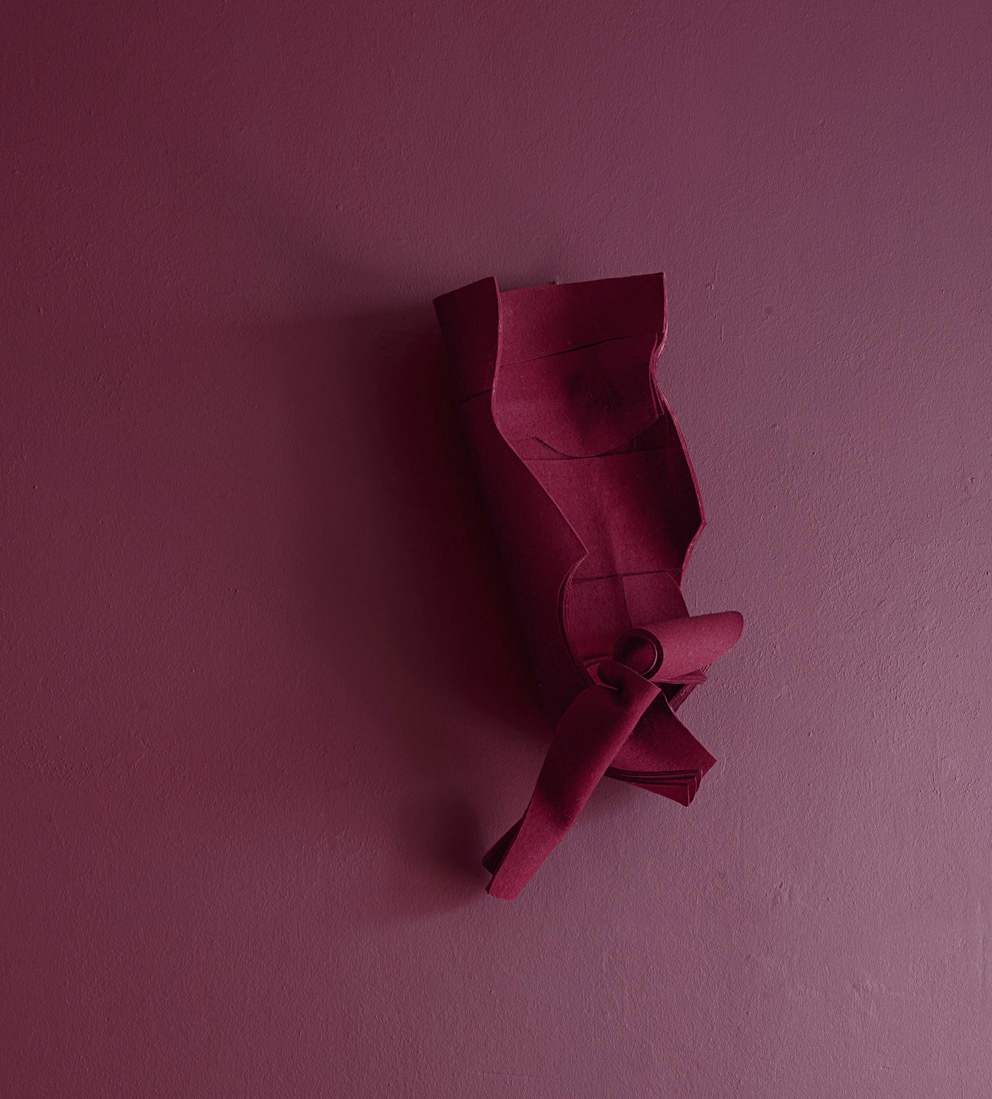
Puzzle, particolare, feltro.
Beyond the register of representation, through her life-size imprint sculpture, De Lorenzo composes a high relief of bodies projecting from the background, segmented into a series of volumes, masses, lights, and shadows that does not simulate but exposes the elusiveness of the subject and the incongruity of the pose: real and anatomically impossible, concrete and abstract, to be “seen” above all with a bodily sense. The leg twisted in a contortion that screws the foot onto itself; the undersized arm in the bandage of the upside-down torso; an elbow that welcomes the fall or rise of the lower limb, the abandonment of the neck on the shoulder and the invisible and deposited weight of the head. A “tactile” sensation, localized entirely on the periphery, on the edge of the felt (or skin), the threshold of touch, between me and the other, a boundary that opens rather than closes. What we see happening from wall to wall is this continuous sliding, wandering, and transiting elsewhere, as if the body were nothing more than its own displacement, a withdrawal from itself that is necessary to open up the infinity of retreating into oneself. (2)
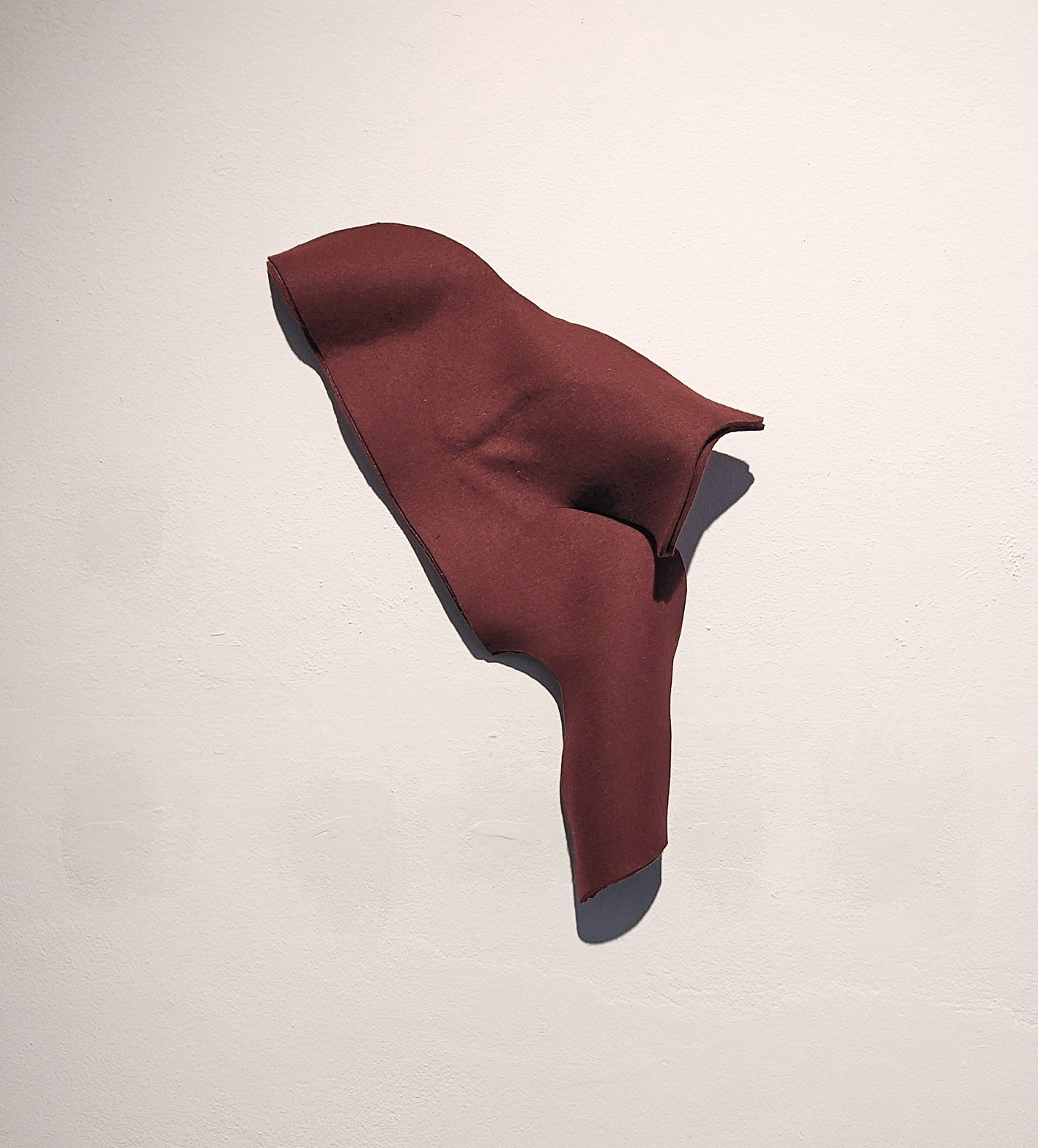
Puzzle, particolare, feltro.
Ciò che resta, (What Remains), from the title of the photographic work exhibited alongside the sculptures, is another trajectory of movements (the rapid movement of the eyes beneath the eyelids during the REM phase of sleep), another transition from invisible physicality (of eye movement) to the incorporeal vividness of dreamlike imagination, in the disintegration and recomposition of the subject. Always inclined to reinvent artistic languages, De Lorenzo creates an image of the body's motility through a visual device that draws on painting: she photographs a reproduction of Cosmè Tura's “Madonna with Child,” the mostcontortionist of Renaissance painters; she isolates a detail of a portion of the face, which is printed, enlarged, duplicated, cut out at the eye, and rotated to give movement to the trajectory of the pupil. A sort of animated collage without glue, potentially mobile and reorientable, in contrast to felt, which, after contact with the body, stiffens in the adhesive that fixes its layers. As if this gaze, both dynamic and sorrowful, were the first clue to reading, on the opposite wall, that other movement of dual and intimate withdrawal of the body—from itself and into itself—embodied in the dense, malleable, and plastic material of felt.
Note1 - Jean-Luc Nancy, Corpus, cit. p. 27, ed. Cronopio, Napoli, 2004
2 - Jean-Luc Nancy, ivi, cit. p. 30